
|
|
|
|
E. Robert Dunn: A Modern Renaissance Man |
|
As a teenager, Dunn was influenced by science fiction televison shows: Lost in Space, Star Trek, Voyage to the Bottom of the Sea, and especially Space 1999, starring Martin Landau and Barbara Bain of Mission Impossible fame. "Something about that show got me as a young man who was coming out of the closet and was bashed every single day, told I was better off dead and never accepted," he tells me. "I had no place in the present, so I looked to the future." "This TV show (Space 1999) was about 311 people who were trapped on the moon as it was blown out of earth's orbit and they all got along. And then they brought an alien on board named Maya who can change into anything and they got along with her and I went, mmmm, here is something I can identify with. So I just kind of got into that show and it was on the same time that I got my agent. And he asked me what I wanted to do. And I said I'd like to write for TV. There is a show I'd like to be on, that I'd like to be involved with. So to make a long story short, I started writing storyline ideas and he shopped them around but by then the show got canceled. I also sent several scripts to Buck Rogers and Battlestar Galactica. And those scripts that never got looked at or whatever eventually became my book series." In Echelon's End Dunn created a world where gay people are the leaders. As Dunn puts it, "straight people have been in charge for how long and the world's really fucked up. So why not step aside and let somebody else take over who seems to have a history of making things better. Look at urbanization: You have a crack town. Gay people would move in, turn it into upscale real estate. Straight people then move in, and it becomes a crack town again. So what would happen if gay people were in charge. If we were the majority and heterosexuals were the minority. And that's the scenario I set up in my storyline. Not better or worse. Just what would it be. And of course, for my point of view, it is a better world on some levels. No world is perfect. There are flaws. And that's where the drama comes out of my storyline. That even if the world was run by gay people it wouldn't be perfect because you still would have minorities. The answer that the reader hopefully gets is that we should all get along and there is no such thing as a minority." Dunn's utopia is only viewed in retrospect, for it is destroyed (with only a few survivors) in Book 1 of Echelon's End. But Dunn promises that in Book 3 the main characters "go home and you find out a lot about what it was like before the War and what the War has done to this paradise." Dunn admits that he drew upon his personal journals to create the main characters in Echelon's End, all members of a nuclear family that escaped doomsday. He based many of the characters upon various aspects of his own personality: "Lunon [the younger son] is me pre-puberty, before the hormones kicked in and wrecked my life. Retho [the older son] is me coming out, when I looked at boys differently than I looked at girls. Moela [the daughter] is my feminine side. A lot of my frustrations at being in love or having crushes on straight men that rejected me is part of her frustration. Nicraan [Retho's partner] is a little bit of my masculine side and my adult side. And then Dara and Capel [the parents] are my parents and/or a combination of strong women and strong men in my lives. So those were my role models."
Next to Echelon's End, Dunn's major literary production is the play LipSync, which he wrote with Mario Locicero. "Mario and I have been friends since 1987," Dunn tells me. "He is like a brother to me. And we share a town house together. "Lip Sync was born out of a conversation I was having with Mario. We were just sitting around and talking about our lives. And we were going through the pros and cons, and reminiscing about friends who have died and he said, you know, this is funny. So I said, why don't we, for posterity's sake, and in memorial to those who left us, write it down. So we started writing it down and from that we got a rough draft of a play. We never thought it was going to go anywhere, but at the time I was involved in a writer's group at the old GLCC [Gay and Lesbian Community Center of South Florida]. I just presented it on a lark as a project that I was working on at the time. And I guess people liked it. And they said you really should do something with this. And to make a long story short, we did a couple of workshop readings and a theater festival in West Hollywood (2000) and one in New York (2002). And now I am trying to bring it here, to South Florida." "In essence, the play is about friendship and what Mario and I perceived it to be. The gay community is a wonderful community. I love being gay. I have fun being gay. But it has its flaws. And Mario and I felt is that we [the community] need to grow up. And we looked at a lot of the gay plays that are out there and they all each have stereotypical queens. And they all have a nude scene or something like that. And it's all farcical and it's all caricatures. I could not identify with any of those characters." LipSync, Eston continues, is also "about self-actualization. And it's called LipSync for various reasons. They [the characters] lip-sync to various songs. And when people don't have an opinion of their own they will lip-sync somebody else's opinion to fit in with the crowd. But also, when people speak alike, when like minds come together, their lips are in sync. 'Cause truth is truth is self-actualization is self-actualization and that is eternal. And these characters' journey is inward, not outward. They are pretty people who go to the gym but don't do drugs, don't drink, and don't have sex parties. But they still want love and they still want all the things that non-pretty people want. They go inward and they bond together as friends and they do therapy - together - and they get the people that love them to do therapy. Because if you want to be me with me, you either go with me or have a nice life. Goodbye. And that's what the play is about."
Dunn has nothing but praise for Chris Yoculan, the installation artist who ran the annual Arts Explosion and other projects for ArtsUnited. Yoculan's resent resignation as Vice President of ArtsUnited does not surprise Dunn. "I am very sad to see Chris go. But Chris is an artist and he is burned out because he has done it all. Now it's time for the community to step forward. Yoculan planted the seed, and made it grow. It's now time for the community to come forward and take care of the vine. And if the community doesn't, then ArtsUnited won't make it. That would be sad because one reason why I put together [ArtsUnited] was to prove that we can come together. That we as South Florida artists are worthy artists, and worthy of all the benefits of coming together."
|
|
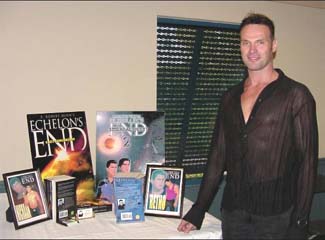 Author Eston Robert Dunn with a collection of his science fiction works
 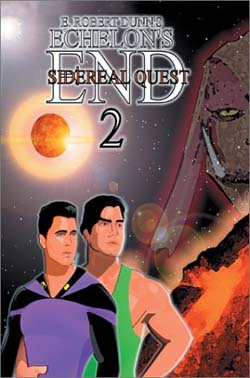 One of the most interesting concepts that Dunn created for his universe is Ka-tela, a second puberty that Retho goes through in Book 1. "I always thought that puberty wrecked my life, because it came too soon. And I always thought that it would be great if you could go through a physical puberty and stay focused. Because before puberty I was a focused young man. I knew what I wanted. I was driven. I wasn't distracted by anything, no hormones, no nothing. And then puberty hit me and then I couldn't think about anything else except men. And I kept getting distracted. Even to this day, at 41 I am still getting distracted because of hormones. [smiles] So I thought it would be great if puberty could be delayed long enough so you can get your education. You found out who and what you were. You have self-esteem. And then, when it hits, you make better choices."
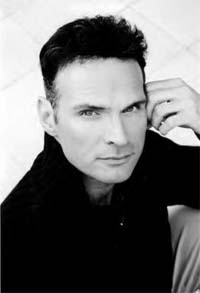 In addition to writing science fiction, Eston Robert Dunn is also a playwright, actor, dancer, Anatomy and Physiology professor and part-time personal trainer
  Jesse Monteagudo is a freelance writer and gay activist who lives in South Florida. His e-mail address is